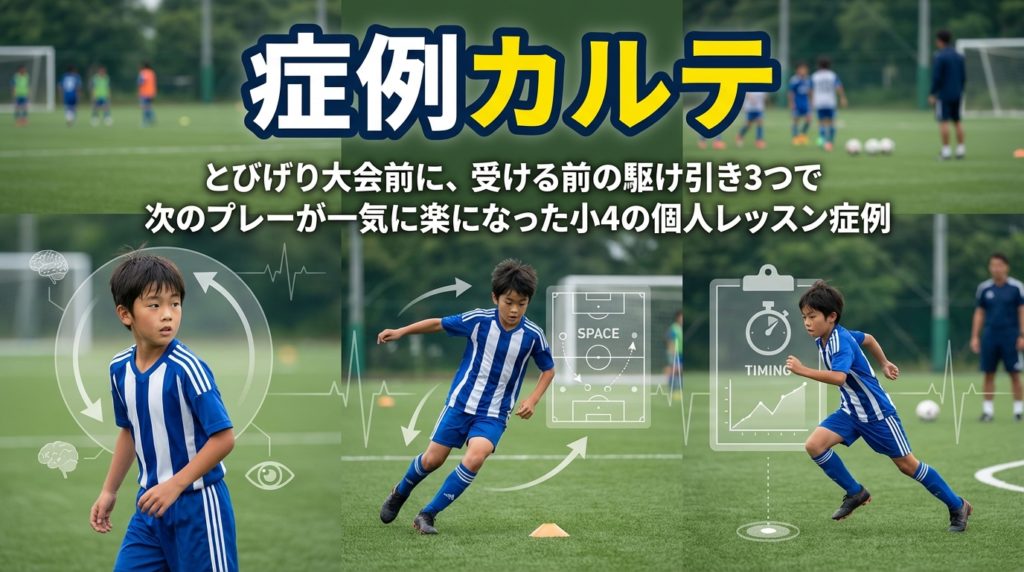
Youth Soccer Case Study: Three Pre-Receiving Tactics That Simplified Play Before a Tournament One-on-One Training for a 4th Grade Player
1. Basic Information
Player: Brothers receiving attention from multiple J-League academy scouts (4th grade & 6th grade)
Today’s focus: Younger brother (4th grade)
Timing: Pre-tournament adjustment (before the Tobigiri Tournament)
Format: One-on-one private session
2. Main Concerns
Based on the parent interview, there were three main issues:
- After receiving the ball, there are moments with no clear passing options
- Improving long-range shooting in match situations
- Improving accuracy on direct volleys from bouncing balls (including half-volleys)
3. Key Points Confirmed in the Pre-Session Interview
- Situations where “no passing option” occurs (receiving position, distance to opponents, teammates’ movement)
- When long-range shots are taken (moments when space opens, moments when pressure arrives)
- Which types of volley situations cause mis-hits (ball bounce, approach angle, contact point)
- With the tournament approaching, the goal was set as “making quick adjustments to feel confident going into the competition”
4. Assessment
For volley and half-volley shots, the understanding of shooting form (body mechanics) was unclear, making it difficult to create consistency.
For long-range shots, the main issue was not the shooting form itself, but the inability to enter a “shootable situation” within the flow of the game.
Regarding “no passing option,” the problem was not decision-making after receiving the ball.
Instead, a lack of positioning and negotiation with defenders before receiving meant he often faced pressure head-on.
5. Interventions (What We Did in the Private Session)
Because this was just before a tournament, the focus was on quick consolidation.
We intentionally inserted different drills between repetitions, creating spaced review and repetition to firmly fix the sensations.
(1) Correcting Half-Volleys and Direct Volleys from Bouncing Balls
- Organized shooting form from the ground up, creating reproducible body mechanics rather than relying on feel
- Made fine adjustments on the spot to increase clean contact and accuracy
(2) Improving Long-Range Shooting (Game-Based Training)
- Recreated match situations and prioritized entering “shootable positions” within game flow
- Adjusted preparation and decision-making for shooting before pressure arrives and when pressure is applied
(3) Solving “No Passing Option” at Its Root
- Taught three key ways to negotiate with defenders before receiving the ball
- This alone significantly reduced situations with no passing options and allowed smoother transitions into the next action without facing direct pressure
6. Before / After
Before:
After receiving the ball, he sometimes struggled due to a lack of passing options.
Volley technique was inconsistent due to unclear form, and long-range shots were hard to execute within match flow.
After:
By learning three negotiation techniques, he was able to enter the next play without facing pressure more often.
Understanding of half-volley form improved, leading to more consistent contact.
Long-range shooting also improved in game-based situations, and overall pre-tournament concerns were effectively resolved.
7. Parent Feedback
“This makes us feel confident going into an important match,” the parent commented.
8. Player’s Condition
Seeing the players’ smiles at the end of the session allowed us to send them off in a positive state of mind.
The session concluded with a great atmosphere leading into the upcoming matches.
9. Coach’s Commentary
“No passing option” often looks like a problem of decision-making after receiving the ball, but in most cases it is determined by preparation and negotiation before receiving.
Once this is organized, the probability of moving into the next action without facing pressure increases dramatically.
Volley shots lose consistency when they rely purely on feel.
The moment form understanding clicks, accuracy can improve significantly even in a short time.
Before tournaments, rather than increasing volume, focusing on key points and designing sessions for quick consolidation is most effective.
This time, intentionally spacing review and repetition led to a fast and solid finish.
10. Summary
- Problems after receiving the ball can be solved through pre-receiving negotiation
- Half-volleys become reproducible through form understanding
- Long-range shooting depends on entering “shootable positions” within game flow
- Before tournaments, narrowing focus and consolidating quickly is key
11. Contact
If you are struggling with issues such as:
- No passing options after receiving
- Getting stuck under pressure
- Inconsistent volley contact
- Wanting to eliminate concerns before an important tournament
We assess the situation and make the fastest possible adjustments on the spot.
Please feel free to contact us for private lesson inquiries.