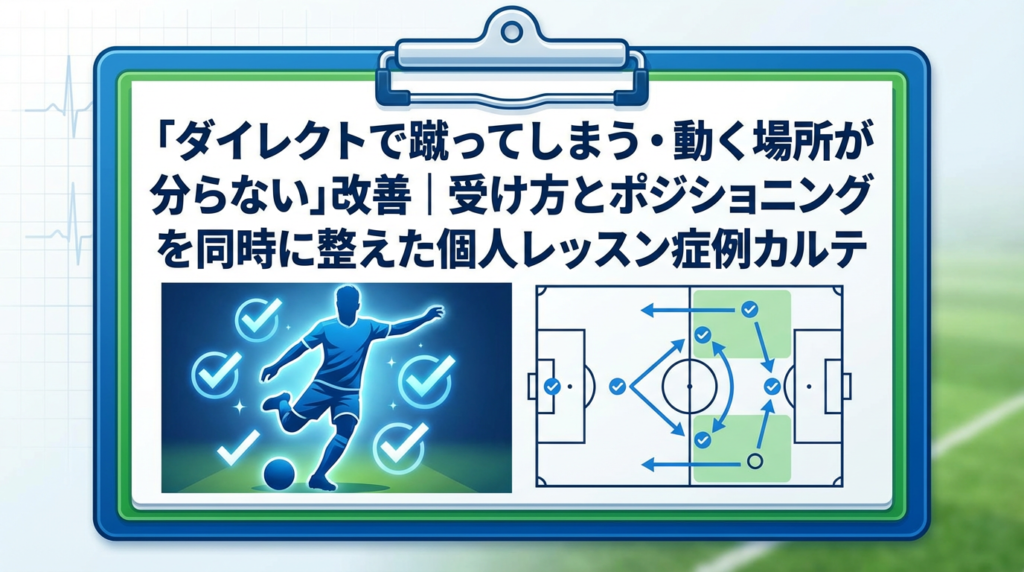
Case Record: Correcting First-Touch Errors and Positioning How Receiving Skills and Movement Were Improved Together in a Private Session
1. Basic Information
- Grade: 3rd grade (Elementary School)
- Position: Not fixed (still developing)
- Main Issues: Playing one-touch passes too often / Not knowing where to move (positioning), resulting in limited involvement with the ball
2. Main Concern
During matches and training sessions, the player often plays the ball one-touch immediately upon receiving it.
In addition, because he does not yet understand where to move (positioning), his overall involvement with the ball is limited.
The goal of this session was to improve both of these issues.
3. Pre-Session Interview (Progress So Far)
From his father, we received positive feedback on recent progress:
“He has started doing self-training,” “His movement looks more energetic,” and “He has improved a lot.”
For this session, we moved to the next stage—improving the quality of “receiving” and “movement.”
4. Assessment (Identifying the Root Causes)
Rather than attributing the frequent one-touch play to mindset or decision-making, we examined the fundamentals.
The following three factors were identified as the main triggers:
- The basics of ball control (first touch) were not clearly established
- No structure had been introduced for controlling the ball while moving (moving first touch)
- Knowledge of where to move (positioning) was largely undeveloped
As a result, the player lacked both “preparation to receive” and “freedom after receiving,” making one-touch play the safest and quickest escape option.
Once these foundations are in place, one-touch play itself is no longer a problem—it becomes a choice that can be used selectively.
5. Intervention (This Session’s Approach)
This session combined knowledge input with practical application that could be executed immediately on the field.
- Introduced basic positioning rules and organized where to stand and how to move in different situations
- Trained body alignment and weight transfer specifically for effective ball control
- Worked on running patterns and entry angles to naturally create an open body position when receiving passes
6. Before / After (Observed Changes)
Before:
Lack of understanding in how to receive the ball led to over-reliance on one-touch play.
Unclear positioning limited involvement with the ball.
After:
A structured first-touch technique with proper body alignment and weight transfer improved preparation before receiving.
Improved running patterns allowed him to arrive earlier in positions where he could receive the ball more effectively.
7. Parent Feedback
“He seems to understand it much better now, so I’m looking forward to seeing him try it in real games,” his parent commented, bringing this session to a close.
8. Expert Commentary
The key point of this session was not “stopping one-touch play,” but building the foundations to “control,” “move,” and “receive.”
Players who rely heavily on one-touch play are often not making quick decisions—they simply lack the time and space to receive comfortably.
That is why designing the first touch and organizing body orientation and entry angles before receiving is the fastest route to improvement.
Conversely, positioning knowledge alone leads to limited results.
Only when receiving technique improves does positioning begin to make sense at a physical, intuitive level.
9. Direction Going Forward
- Connect “arriving early in receivable spaces” to “turning forward” in match situations
- Do not eliminate one-touch play, but clarify the conditions under which it should be used
- When involvement drops, break the cause down into positioning, movement patterns, or receiving technique, and correct accordingly
10. Contact / Call to Action
Concerns such as “always playing one-touch” or “not knowing where to move and failing to get involved” are very common.
In many cases, the root cause lies not in decision-making, but in preparation before receiving the ball.
We identify the cause on the spot and adjust it according to the situation.
Please feel free to contact us if you are interested in private training sessions.